
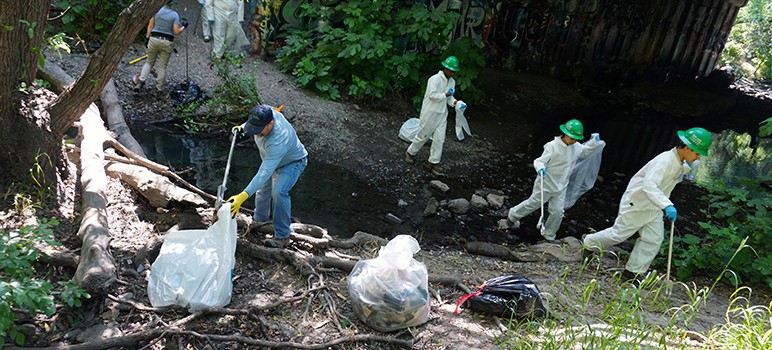
San Jose city officials today began the process to clear Coyote Meadows, a city-owned parcel of land located near the intersection of Story and Senter Roads that is one of the last large homeless encampments in the city.
The site, formerly known as “the Jungle,” is home to approximately 100 unhoused individuals, according to the city.
City staff began notifying individuals living at the encampment that the area will be cleared starting April 15, marking the beginning of at least 50 days of outreach efforts to provide social services and relocate people to interim housing.
The city is reaching out to people at the site, where interim housing will be offered, as well as the distribution of written materials in English, Spanish and Vietnamese. Before issuing the notice, city staff conducted a manual count of people at the site.
“Over the last three years, we’ve expanded shelter and interim housing faster than any other city on the West Coast,” said Mayor Matt Mahan in a statement. “That work has allowed us to decommission our largest encampments so that we can restore public spaces for community use and connect people to the services they need to return to self-sufficiency.”
“Clearing Coyote Meadows is about balancing compassion with responsibility,” said City Manager Jennifer Maguire. “For the next several weeks, our teams will be on site every day offering shelter, services, and support to help people move indoors, while also beginning the work to restore this important area along Coyote Creek. Together, we are creating a San José for everyone — protecting public spaces and waterways, and strengthening the overall health, safety, and beauty of our city.”
The purpose of the Coyote Meadows abatement is to provide services to individuals experiencing homelessness in the area while restoring local waterways as the site transitions to a no encampment zone, according to the city.
The site will become a designated a permanent “No Encampment Zone” to prevent re-encampment. Once clearly marked with posted signage, the city can immediately remove any encampments found in the area without additional notice, as the signs serve as permanent notification.
San Jose is required to reduce the amount of debris and pollutants flowing into Coyote Creek to maintain compliance with its stormwater permit requirements. The abatement is expected to last 30-60 days, depending on weather and other site conditions.
The recent opening of the Cerone Interim Housing site created additional interim housing capacity which will support outreach efforts, allowing for placements for those exiting the encampment. Past abatements coupled with on-site services and support have yielded higher acceptance rates for housing and shelter than traditional referrals and waitlists.
The city promised to provide ongoing updates to keep the public informed as outreach, clearing, and restoration efforts continue.
The city said it will follow a procedure for handling individuals’ personal property at the encampment, if it is approved by the City Council on March 3.
The procedure, according to the city, is designed to protect items essential to a person’s identity or health. Clearly identifiable and indispensable items — such as government-issued identification and prescribed medications — will be impounded and handled in accordance with the city guidelines.
The advance notice provided before abatements is designed to give individuals time to organize and take their belongings. Most people gather their possessions and leave the site prior to the abatement, according to the city.
When items must be impounded, they are documented and stored securely. Individuals may coordinate retrieval by phone or email, or request delivery if transportation is a barrier.
If the City Council approves updates to the procedure on March 3, staff will clearly communicate instructions for retrieving property. Written and verbal instructions will be provided in English, Spanish, and Vietnamese.
This large encampment along Coyote Creek — formerly known as “the Jungle” — existed for many years before the city dismantled it in 2014, relocating hundreds of residents and fencing off the site to prevent re-encampment.
Since then, periodic abatements and creek cleanup efforts have taken place as the city balances public safety, environmental protection and outreach to connect people with services and housing in the area.

The Jungle was cleared over a decade ago, but suddenly now there are hundreds of homeless there? How did that happen? This time they won’t be allowed to return? Why will things be different than the last sweep? (By the way, when they cleared the Jungle, City officials said there would be housing for everyone evacuated. They lied. Hundreds were simply dispersed into neighborhoods.)
Why is the mayor running for governor on a mission-accomplished platform when the City of San José is still playing whack-a-mole?
We can expect the same results. Spend lots of taxpayer money to clean the area up and ‘move’ the homeless. With 3 – 6 months we will see them return and the process start again.
Happens all over, because they don’t have the conviction to enforce a non-encampment zone. We see it with previous clean ups, at Columbus Park and the no-RV parking enforcement.
At least you’ll remove all the trash and make it pretty for them.
Waste of money, but we can’t stop them from spending it.
It’s a delicate balance between restoring natural spaces and supporting vulnerable people. The announcement of the 50 days of awareness is a good thing, and I really hope that temporary housing solutions like the Cerone site will be sufficient to accommodate everyone with dignity.
Yes, but this time there will be a sign…
When “The Jungle” was last cleared, the homeless dispersed throughout the City and set
up new encampments. The result was encampment-related problems in new areas of the City, including mental health emergencies,
drug overdoses, arson fires, theft, assaults, etc.
Does the City of San Jose think that if 100 persons are evicted from their “home”, that they just disappear? No, they have to find a new “home” and they take their problems with them. Short-sighted thinking by the City – Again!
So this is the EXACT same process as done in May 2012
The definition of insanity is doing the same thing and expecting different results.
But who is insane the homeless or San Jose?
LOL… “One of the last encampments” I’ve heard that one before. Like five times before. Sweeping encampments just relocates them. They never permanently go away. San Jose’s council and mayor are LIARS and THIEVES.
NO offense, so your suggestion would be?? What is the solution to this ongoing problem? can’t put everyone in jail, run them out of town? what is your take, again not trying to step on toe.
Here’s a suggestion…use the tens of millions of dollars that are flushed down the mighty Guadalupe to buy up houses in Gary, Indiana….its a win-win….houses for all the homeless with money left over for treatment and a clean river before/after the World Cup…Is Andy sleeping?