
Jaz Roche, also known to nearly 11,000 Tiktok followers as @spo0kymom, hawks facial cleansing bars, baby wagons and AI tools in short social media videos.
On a website where clients can pay her to post videos about their products, she says she’s based in Pennsylvania. Yet the content creator has taken an interest in the California governor’s race lately.
Tiktok and Instagram accounts linked to Roche have posted 34 times in the past 10 days to boost the campaign of billionaire Tom Steyer or to criticize his main Democratic opponent, Xavier Becerra.
“Hear me out, I have something to admit,” she says in the first video, posted May 8, on an account where she describes herself as a “so-cal girlypop.” “I did not expect the most progressive governor candidate to be a billionaire. But look at the policies, you guys.”
What she didn’t say was that Steyer’s campaign is paying her to say it.
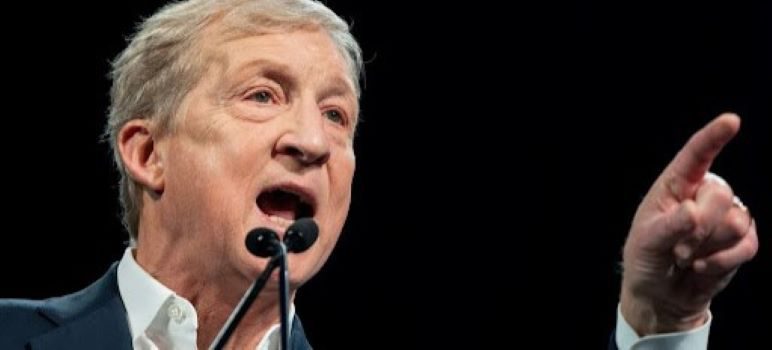
Steyer, who has poured nearly $200 million into the most expensive primary campaign in state history, is under scrutiny for using paid social media influencers to post favorable things about him.
Is that legal?
Gov. Gavin Newsom three years ago signed a law meant to bring transparency to the increasingly intertwined world of politics and content creators, enacting a law requiring influencers to be upfront in their posts about being paid by a political campaign. In one of the first tests of the law, regulators have opened an investigation into one of the Steyer influencer videos.
But experts and transparency advocates aren’t optimistic: The law was intentionally designed with no real penalties, and the agency responsible for enforcing it sometimes takes years to resolve investigations.
“This is where the ‘Wild West’ analogy becomes useful,” said Dan Schnur, a political science professor and former chair of the state’s Fair Political Practices Commission.
‘Inundate the internet’
Campaign finance filings from January through April 18 show Steyer has paid over $123,400 to at least eight influencers. The New York Times reported that includes $100,000 to Texas-based Latino mega-influencer Carlos Eduardo Espina, whose 14.3 million Tiktok followers are a coveted target for Democrats and who has endorsed Steyer.
The campaign is also paying over $870,000 to a digital media agency, Group Project Digital, that solicits creators to post daily videos about Steyer. The listing initially offered $10 per video; it was amended last week to offer $1,000 a month and now includes a sentence telling creators they need to disclose the payments..
The state investigation covers just one of the influencer videos, in which content creator Isaiah Washington (known as @zaydante) did not disclose that Steyer’s campaign paid him $10,000 for a now-deleted video. It was sparked by a complaint from a pair of political social media influencers who post frequently in support of Becerra.
On Tuesday, they filed another complaint alleging numerous additional paid, undisclosed posts, including from accounts in other countries.
“What he’s done is inundate the Internet in every way, shape and form to try and create an echo chamber,” said Beatrice Gomberg, one of the complainants.
Among the accounts they’ve recently highlighted: @foosgonewild, which has posted memes, content about Southern California street culture and, on May 5, an interview with Steyer talking about his opposition to ICE. The account has 3.3 million followers on Instagram and 1 million on Tiktok.
The Tiktok video has no disclosures. On Instagram, at the bottom of the video description, the account notes it’s a partner with California-based social video firm Flighthouse. Neither the content creator nor Flighthouse responded to requests for comment. The Steyer campaign would not disclose how much it paid the firm.
Steyer has defended soliciting influencers, saying they deserve to be paid for their work.
Spokesperson Kevin Liao called Gomberg’s first complaint “baseless” and said the campaign specified in its contracts with all third-party content firms that they needed to include payment disclosures, satisfying the campaign’s legal obligations under the state transparency law. The campaign doesn’t review posts in advance, he said.
Asked why the campaign had paid some creators who don’t live in California, he said, “I don’t see why that’s an issue.”
“Content creators, wherever they’re based, have followers in California,” he said.
‘Politics is all content now’
The blowback reveals the rising power and profitability of content creators in politics. One in five Americans regularly gets news on TikTok, rising to more than two in five for those under age 30. With traditional television hemorrhaging viewership and Americans hooked on the infinite scroll, campaigns are increasingly chasing posts.
They regularly hold events to court paid and unpaid influencers and sit for video interviews, aided by a new crop of talent agencies and digital media firms that represent influencers and solicit their content.
The relationship has contributed to at least one politician’s downfall: After attending a creator meeting for then-gubernatorial hopeful Eric Swalwell last fall, political influencer Arielle Fodor (aka @mrs.frazzled) received a flurry of messages warning her to stay away from him. It prompted her to post videos discussing rumors of his sexual misconduct, she has said. He quit the race after reporters covered several allegations of harassment and assault.
“Politics is all content now,” said Alex Stack, a Democratic consultant and former communications staffer for Gov. Gavin Newsom. “Candidates need to be content creators and they need a little online army behind them to get traction.”
Roche’s videos about Steyer — some featuring her talking, some simply showing text praising Steyer over mundane videos of her life — have gotten no more than 1,100 views each. They’re posted on accounts with fewer than two dozen followers, a far cry from the millions of Californians Steyer’s TV ad spending blitz is reaching.
But they provide something critical for the billionaire candidate who’s funding his own campaign: the impression of grassroots support.
In a briefing memo for creators obtained by CalMatters, the campaign’s digital firm tells Tiktokers and Instagrammers that the “title of billionaire is his biggest sticking point,” and that the campaign wants to reach California women, Latinos and African Americans. The Sacramento Bee first reported on the memo.
Organic content?
Advertisers covet creators regardless of audience size for their ability to portray a product endorsement as an organic recommendation from a friend. Candidates courting voters are no different.
For example, an organization representing California lawyers is paying influencers to promote a ballot measure targeting Uber’s responsibility for sexual assaults by its drivers. Matt Mahan’s campaign for governor has also paid influencers and meme accounts for content boosting him. Instagram users see disclosures on those videos’ descriptions.
In the Los Angeles mayor’s race, Karen Bass’ challenger Spencer Pratt is offering money on social media gig platforms to make videos featuring viral-friendly soundbites of him.
Serabeth Mullaney, a part-time San Francisco content creator promoting cat treats and AI tools, turned down an offer to make videos boosting Steyer’s campaign because of her opposition to billionaires in politics. The 29-year-old said she gets most of her news from social media so she’s concerned about the seep of paid political ads into influencer content.
“Anyone desperate to make that (money), they’re going to do the campaign,” she said. “Whether or not they believe in Tom Steyer, they’re going to post those videos.”
The concern mirrors the state Fair Political Practices Commission’s rationale for proposing the 2024 transparency law. Before that, campaigns only needed to disclose payment for ads they posted directly; paid content on third-party platforms was largely unregulated.
But the agency primarily relies on complaints to launch investigations, and violations of the law come with few consequences — no fines or criminal charges for creators or campaigns. The only thing the agency can do is ask a court to force an influencer to disclose payments, but experts say that’s an expensive and time-consuming effort for a fleeting video.
Sen. Tom Umberg, a Santa Ana Democrat who authored the law, said paid influencers in politics are more prevalent than three years ago and lawmakers should make the requirements more enforceable.
“Transparency is like whack-a-mole,” Umberg said. “Every year there’s a new modality, and so there’s a new way to get around stuff.”
Becerra’s online army
Now the gubernatorial candidates and their supporters are engaged in a mass scrutiny of all the posts boosting each others’ campaigns.
Critics have also questioned the relationship between Becerra and numerous creators who have boosted his campaign since Swalwell dropped out. The Becerra campaign has insisted it has never paid any content creator for a post.
The campaign seeks relationships with creators who are willing to post for free as a blend of campaign volunteer and reporter, said digital strategist Alf Lamont.
“Paid influencer campaigns don’t carry the kind of punch that organizing does,” Lamont said. “We want to make sure we’re getting folks who truly believe in it so we don’t face the second-guesses and the ‘paid by’ and the feeling you’re looking at something that’s insincere.”
Jordan “Jay” Gonzalez’s posts included lifestyle content, Latino advocacy and even salmon DNA facials before he started creating pro-Becerra videos on multiple platforms in March, a month before the campaign hired him as a full-time social media strategist. Gonzalez has recently been amending his posts with disclosures that he is paid by the campaign, “out of extreme caution so as not to seem disingenuous to my audience.”
Opponents point out Gonzalez and another creator who has posted numerous times in Becerra’s favor, Maggie Reed or @mermaidmamamaggie, have previously charged for content. Antonio Villaraigosa’s campaign solicited unpaid videos from both of them in the spring, and received quotes from each influencer’s agent of $7,000 to $16,500, emails shared with CalMatters show. The Villaraigosa campaign confirmed the exchanges.
On Tuesday, Steyer’s campaign filed a complaint alleging both influencers’ videos were paid for by Becerra’s campaign with no disclosure.
Becerra’s campaign has not reported any payments to Reed in campaign finance filings, and Lamont denied paying either creator for content. Gonzalez, in an email, said that he had previously declined a paid offer from the Villaraigosa campaign. Reed did not respond to a request for comment.
‘A SoCal girl’
Gomberg and Kaitlyn Hennessy, friends who met at a Becerra rally, have both posted frequently in favor of his campaign — for free, they say.
The pair began sleuthing online in early May, eventually filing a complaint with the Fair Political Practices Commission last week alleging Steyer’s campaign hired Roche, Washington and several other content creators to post on his behalf without disclosing it.
Posing as another, unnamed campaign, they emailed creators offering paid political content work to prompt them to talk about posting for Steyer’s campaign.
One account, @isabel.speakss, purported to belong to a “so cal girl sharing her thoughts” named Isabel Mendoza and has exclusively posted about Steyer since May 9. The woman in the videos appears identical to Jade Johnson, a Florida-based influencer.
Another account, @jess.votes, is linked to another Florida content creator.
Since the complaint was filed, Roche and the other creators have included disclaimers in their posts. None of them responded to inquiries from CalMatters asking if they knew about the campaign disclosure law. After a CalMatters reporter asked Johnson whether she was asked to pose as a California voter, the @isabel.speakss account on Monday afternoon removed the “so cal” description from its profile.
None of those creators are listed in Steyer’s latest campaign finance filings as subcontractors of any digital strategy firm. Steyer spokesperson Liao said they will appear in the next filing.
CalMatters reached out to all the creators listed in the filings; none agreed to an interview. They include lifestyle influencers, comedians and musicians whom Steyer paid between $1,500 and $10,000, mostly through another firm, to post video interviews with Steyer or talk about his platform. One of them labeled her video a “paid partnership;” others did not disclose campaign payments or have since deleted their videos.
Jeanne Kuang, Yue Stella Yu and Maya C. Miller are reporters with CalMatters.

Gosh
Ed zmcGivrrn and thec49ers have set the stage. This phony online army was first deployed in Santa Clara in 2020.
Recently Santa Clara now tge phony non profit commissioned by York to help Suds Jain was uncovered by fppc in 2024.