
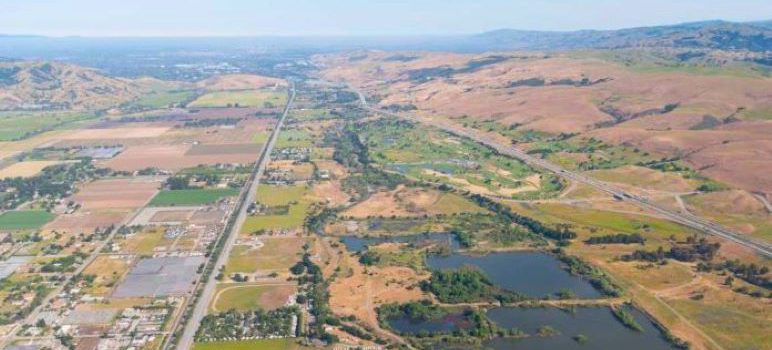
Santa Clara County voters will decide this month whether to approve a parcel tax that would generate an estimated $17 million annually for the Santa Clara Valley Open Space Authority, funding wildfire risk reduction, water protection and open space conservation across the region.
Measure D qualified for the June 2 primary ballot as a citizen’s initiative after organizers collected 43,770 signatures, over the required threshold of 37,206. It would levy a tax of 2 cents per square foot of building area annually, with a $7,500 per-parcel cap. The levy would add $30 to the tax bill for a 1,500-square-foot residence.
The measure includes exemptions for low-income residents and seniors, as well as requirements for annual audits and independent taxpayer oversight.
Open Space Authority General Manager Andrea Mackenzie said the agency has been managing a rapidly expanding portfolio on a budget that has remained stagnant for more than a decade.
“Since 2014, the acreage we are responsible for protecting and opening to the public has doubled to 30,000 acres,” Mackenzie said. “And yet we’re operating on the same revenue stream today as we were 12 years ago.”
The authority currently receives about $12 million annually in flat revenue. Mackenzie said that figure is insufficient to maintain existing lands, let alone the additional 10,000 to 15,000 acres the agency projects it will take on during the next 15 years. Without new funding, she said, the agency’s ability to steward and maintain protected lands would be severely diminished.
“Lands that have been protected to date by the Open Space Authority and its partners are permanently protected,” Mackenzie said. “But can they be continued to be cared for, restored, and maintained, to provide the natural services and benefits to the public that we’ve come to depend upon? Without additional funding, we will be severely limited in future years to be able to steward and maintain these lands.”
According to the authority’s plan, Measure D revenue would be directed toward vegetation management to reduce wildfire risk, restoration of natural floodplains and wetlands, wildlife corridor maintenance between the Santa Cruz Mountains and the Diablo Range, and expansion of the public trail system from its current 30 miles to a projected 60 miles by 2041.
The measure was placed on the ballot as a voter-sponsored initiative, a mechanism subject to a lower approval threshold than an agency-sponsored special tax. Spearheading the initiative were Clara County Supervisor Kenneth Yeager, Valley Water board member Shiloh Ballard, and Julie Hutcheson, executive director of advocacy nonprofit Green Foothills.
Hutcheson said voter response during signature gathering was broadly positive.
“People just appreciate the Open Space Authority and the work they do,” Hutcheson said. “If you double your work but don’t increase your revenue, that’s hard to maintain.”
Hutcheson noted that the tax’s structure, which scales with building square footage rather than assessed land value, was designed to be equitable. Large commercial and industrial property owners will pay more due to greater square footage, but are subject to the $7,500 annual cap.
Critics of the measure argue it is both fiscally unnecessary and legally flawed.
Mark Hinkle, president of the Silicon Valley Taxpayers’ Association, contends that open space management is already the county’s responsibility and should be funded through the Board of Supervisors’ budget.
“Whatever the Open Space Authority does applies to Santa Clara County and should be in the county’s budget, not a separate authority with its own growing bureaucracy,” Hinkle said. “If it’s important, it would be funded there.”
Hinkle also challenged the credibility of the measure’s oversight provisions, dismissing the promised annual audits as inadequate.
“It’s like a defendant in a jury trial being allowed to pick his own 12 jurors,” he said. “The auditors are selected by the district. It’s basically a rubber stamp—that is standard operating procedure for every government bureaucracy.”
On the senior and low-income tax exemptions, Hinkle expressed skepticism that most eligible residents would actually benefit from them, saying applicants would effectively have to submit tax returns to the Authority to qualify and would likely need to reapply annually.
“They put the exemption in to get the measure passed,” he said. “But are they really going to proactively make it easy to apply? No. That’s not going to happen.”
Hinkle argued that the measure adds to the property tax burden for residents and businesses.
“People are very concerned about the cost of living, and this is not going to help,” he said. “California lost a million residents over the last decade. When people reach retirement, virtually all of them are leaving California because they can’t afford to stay.”
Supporters are urging voters to act before open space lands are lost to development or damaged by wildfire.
“Later is too late,” the proponents’ Notice of Intent states. “We need to act now to protect our natural open spaces from overdevelopment before they are gone forever.”
Measure D requires a simple majority to pass. The June 2 Statewide Direct Primary Election ballots were mailed to all registered voters in Santa Clara County. Early voting began this week.

Eliminate property taxes altogether.
What is a hidden secret is that for decades Santa Vlara County and Gilroy ignored developing the Luvk Hertford Ranches short distance awsy. Dozens of acres of prime land right near Gilroy could have been developed bringing hundreds if millions in taxes
Still considered the best area for several hundred affordable homes. Lucky Hertford remains silent. A testament for county leaders who can’t see past ognirance.
No new taxes, assessments, bonds or parcel taxes. Enough is enough.
The county has a budget, live within it. Stop parsing out every single thing into a new charge. School districts, parks, public transportation, water districts, open space. At the same time they are waiving fees for on new builds under the guise of affordable housing.
Figure out what it cost to run the county, tell the taxpayers, so they can decide how much they are willing to pay. Prove you can manage the budget and not just keep demanding more from our paychecks.
This was a big reason Prop 13 was originally created in the 70’s, to force the local government to operate within their means. All the workarounds that have been used to add thousands of dollars in additional charges to the property tax bill in the form of fees, bonds and assessment does absolutely nothing to help with housing affordability in the region.
In addition to the issues raised by Hinkle there are other issues in the proposed ballot measure that should be of great concern to voters and those are:
1) the tax calls for an automatic annual increase tied to the CPI inflation rate without a further vote of the people.
2) the exemption for the disabled only applies to those who receive SSI or SSD but there are many who receive disability benefits from many other sources.
3) to qualify for the low income exemption for those who are poverty stricken. The ballot measure specifically states that it is based on the 2012 poverty guidelines. 2012??? Give me a break.
The measure is permanent and can only be terminated with another vote of the people. The measure fails to disclose the process to actually do that is complicated and there are a number of pitfalls that must be navigated to place a tax recall on the ballot.
This is a big NO for our family and she be a big NO the the voters of Santa Clara County.
I live next to open space and the park service they have not done anything in the 11 years that i have lived here to cut brush, trim tree, remove trees, get trees out of the creek nothing. The only thing they are about is getting more land or take it over. The whole area is a huge fire danger but they over care about hiking trails and not the huge amounts of area that needs to be clear cut down. They got around 160 million less than 5 years ago. Where did all that money go? All they are about is buying up huge amounts of land to make the housing prices go up. Less land for people to buy causes everything else to go up.