
Worker pay at the country’s largest four-year public university is uneven, with some employees earning well below and others above national averages.
The findings from a new compensation report show two truths: Overall, unionized staff and faculty compensation at the California State University is on par with national averages for similar public universities, but about a third of workers’ total salary and benefits are below national averages. Between 13% and 19% of workers earn well above the average. The report also found that workers at Bay Area campuses are generally underpaid after factoring in the higher wages employers tend to pay in the region.
The Cal State chancellor’s office paid the Segal Group, a human resources research firm, a little more than $1 million for the 27-page report, according to a Cal State spokesperson, Amy Bentley-Smith.
The conclusions are likely to factor heavily in ongoing and increasingly charged contract negotiations between Cal State and its largest unions, which are demanding raises that currently far exceed what the Cal State system is willing to pay. Cal State has budgeted for 4% raises this year; unions are seeking roughly double that or more.
A Cal State trustee Wednesday said the report shows the university system is on the right track, but it leaves her with concerns that workers with the lowest salaries struggle to pay for California’s high living costs. Benefits, while generous, cannot alone pay for basic needs or allow workers to live close to campus, said trustee Leslie Gilbert-Lurie.
“We want them to be able to have food, and we want them to be able to have housing,” she said. “And so I want to be sure that our base salaries at these lowest levels align with what it means to live in California.”
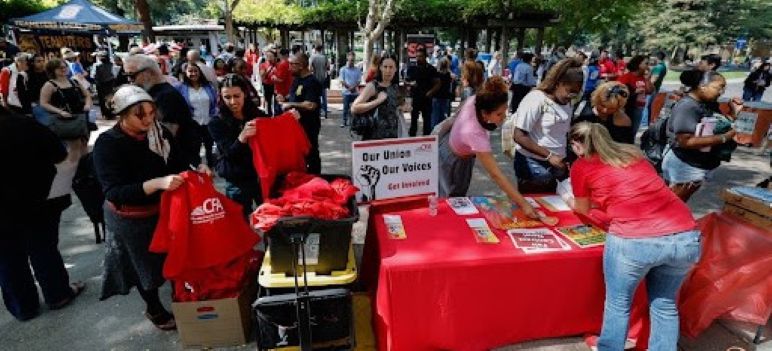
Dozens of representatives from four labor groups briefly shut down the Cal State trustees meeting Tuesday after chanting “no contract, no peace” and “if we don’t get it, shut it down” during the public comment period. All trustees and campus presidents left the meeting space during the demonstration. As the system leaders were exiting, one worker yelled, “Don’t walk out on us!”
Adding to the tension is data that shows 91% of the roughly billion dollars the system got in new money from the state and tuition increases between 2021 and 2025 went toward wage raises for union members. Cal State trustee Julia Lopez first cited the figure at the July meeting, suggesting that steering the majority of new funds to wages is why campuses battled deficits — they struggled to handle all their other growing expenses.
“That’s why every single campus had to really look at their budgets and figure out how to make the adjustments that they needed to live within the money that we were sending to them, and that’s why there’s so much pain in the system,” she said. Lopez co-chaired a working group in 2023 that determined the system is shortchanging its students by not spending enough on academic support and student services, such as libraries and counseling.
Cal State received a record amount of extra taxpayer funding this year, something the unions say was at least partly due to their advocating with state lawmakers. Union leaders are angry their efforts aren’t yet translating into higher wage increases. Meanwhile, Cal State campus presidents received raises of 10% to 20% last year, on top of additional potential bonuses — another source of ire for union leaders.
What unions want
In an interview a few hours after the Tuesday worker protest, a senior union official said that her members don’t want to strike. But they will “strike if they have to for what’s right because a temporary, you know, economic hardship will solve years and years of economic disparity,” said Jessica Dalton, vice president for representation for CSU Employees Union. The union represents over 36,000 support staff, student assistants, and healthcare, technical, and administrative workers.
The union seeks a 7% raise for all its non-student workers in 2026 plus other increases for some totalling an 11.8% increase and a 5% raise in 2027. Cal State countered with a 1.2% increase in 2026 and 4% in 2027. The union wants every eligible worker to receive automatic 2% raises annually if they stay at their positions, a concept known as step increases. Cal State, Dalton said, has opposed automatic step increases and instead wants to move workers up only after signing new labor contracts.
A third of workers are on lower pay steps than they should be based on their experience levels.
The faculty union representing 29,000 professors, lecturers and other employees wants predictable, annual raises that equal inflation plus two percentage points. Cal State instead proposes 3% increases for this year and next. The union also wants the lowest-paid workers to earn at least 10% of the $795,000 salary that Cal State’s chancellor, Mildred Garcia, receives. Right now the lowest-paid faculty receive around $66,000 annually.
The report states that median Cal State salaries for unionized workers are actually 1% below the national average, but the system’s health and retirement benefits are generally more generous than those at other schools, making the overall compensation of workers about 3% above the national average.
Chart: Mikhail ZinshteynSource: Segal GroupEmbed
Unions and university officials disagree over whether Cal State’s proposals will make health benefits more expensive. For CSU Employees Union, Cal State negotiators want to impose a new $5 monthly fee to workers that would grow to $20 for an additional two dependents in 2029. Dalton already pays $100 a month for her health insurance, she said. The extra charges would eat into the raises Cal State is offering, she added. But Cal State notes that employees on the most popular plan, through Kaiser Permanente, will see their health insurance costs drop by $13 to about $150 per month between 2026 and 2027.
Amanda Harrison, a lecturer of English and queer studies at Cal State Northridge, said her health insurance is almost $1,000 a month for herself and her partner — 14% of her salary. In 2018 it was $138 for the same plan, she said. The current rate should be much lower, she contends. Harrison is a cancer survivor and wants the more expensive PPO to access hospitals with research centers. She taught at Santa Monica College and knows faculty there with identical plans who pay nothing.
For the faculty union, Cal State wants to propose a working group to re-evaluate how much the system pays for health benefits. Cal State officials say this group will have no authority to change how much workers will pay for their benefits. But the union is alarmed.
“This would be an unfathomable take-back, causing a reduction in buying power and eroding already low wages,” wrote faculty negotiator Kevin Wehr in an email. He leads the bargaining team for the faculty union and is a sociology professor at Sacramento State. The union is in a dispute with the system over its contract. The next stage of negotiations would permit strikes.
Cal State calculates that its health benefits spending will rise by $81 million between 2026 and 2027.
Union criticism of report
The faculty union is critical of the compensation report because it didn’t consider the much higher cost of living in California compared to other states. The report only considered the higher cost of labor in the state. The differences can be extreme. The report states workers in San Francisco should earn 18% more than workers in Bakersfield. But public calculators show that the cost of living is 50% higher in San Francisco than in Bakersfield.
In a written statement, a spokesperson for Cal State’s Office of the Chancellor, Jason Maymon, defended using cost of labor rather than cost of living. “Cost of living can vary significantly between locations and is an important consideration for employees, but it addresses affordability rather than the market competitiveness of compensation,” he wrote. “Because the purpose of this study was to compare CSU compensation with the external labor market, cost of labor was the appropriate measure for the analysis.”
Another report on non-unionized staff is due by the end of the year. Cal State published a similar report on executive compensation in 2025.
Mikhail Zinshteyn is a reporter with CalMatters.
