
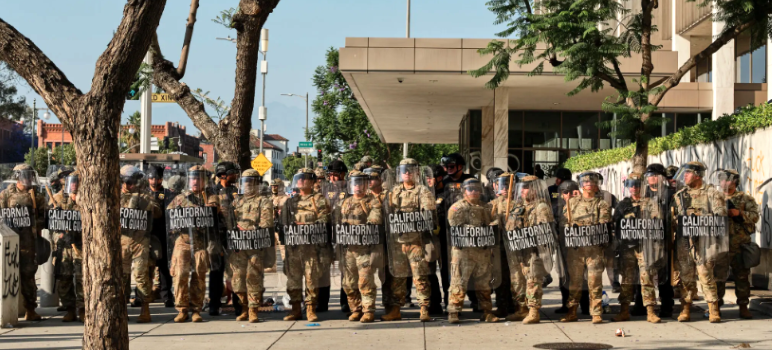
A federal judge has ordered the National Guard to leave Los Angeles and return to Gov. Gavin Newsom’s control in a stern rebuke of the Trump administration’s contention that it can leave troops in the city indefinitely.
The order handed down today goes into effect at noon on Monday.
“It is profoundly un-American to suggest that people peacefully exercising their fundamental right to protest constitute a risk justifying the federalization of military forces,” U.S. District Court Judge Charles Breyer wrote in the opinion.
The Los Angeles case is one of several challenging Trump’s deployment of the National Guard in liberal cities, including Chicago and Portland. The U.S. Supreme Court is weighing a case on Trump’s call-up of troops to Chicago, which could further determine whether the domestic mobilizations are constitutional.
In June, Breyer issued a separate decision against Trump’s Los Angeles deployment, but the 9th Circuit Court of Appeals blocked that ruling from taking effect and allowed the troops to stay.
“Today’s ruling is abundantly clear – the federalization of the National Guard in California is illegal and must end,” Newsom said in a written statement. “The president deployed these brave men and women against their own communities, removing them from essential public safety operations. We look forward to all National Guard servicemembers being returned to state service.”
The Trump administration used Section 12406 of the U.S. Code to justify sending National Guard troops to Los Angeles in early June, when aggressive immigration enforcement operations led to protests. The administration issued similar orders in August and again in October, each time citing the clause that permits Trump to federalize National Guard troops if “the President is unable with the regular forces to execute the laws of the United States.”
In each case, the Trump administration argued that the conditions in Los Angeles in early June justified sending in the National Guard. Trump mobilized 4,000 of the state’s National Guard troops in response to two days of occasionally volatile protests against federal immigration raids in Southern California. Almost of them have returned home.
Before Trump’s federalization of those troops, at no time in U.S. history was the law invoked without the consent of the state governor. Use of the law is exceedingly rare: It was used just once before June by President Richard Nixon to mobilize troops during a postal worker strike in 1970.
“It defies the record — and common sense — to conclude that risks stemming from protests — in August, October, or even present day — could not have been sufficiently managed without resorting to the National Guard,” wrote Breyer, the brother of retired Supreme Court justice Stephen Breyer.
There are three conditions that presidents can use to invoke Section 12406: If the country is invaded or in danger of invasion; if there is a rebellion or danger of a rebellion against the U.S. government; or if the president cannot enforce the nation’s laws with regular forces.
The Trump administration focused on the last one, arguing that previous court rulings found that the president need only be “significantly impeded” from executing the country’s laws, rather than being completely “unable” to execute them, to comply with Section 12406, and argued that the existing risk of further protests justified the continued presence of the National Guard.
Breyer rejected that argument, saying that the mere threat of protests or uprisings compromising the president’s ability to execute the country’s laws is not enough to justify federalization of the National Guard.
“if federalization justified federalization, it would become a positive feedback loop that perpetually rationalized federal control of state troops,” Breyer wrote.
The Trump administration, in its briefings, argued both that the federal mission had succeeded and conditions in Los Angeles had improved, but said the situation still required the presence of National Guard troops.
“Their assertion that ‘[t]here remains an inability to execute the laws . . . in California’ is not only unsupported, but actually borders on a misrepresentation,” Breyer wrote.
Breyer also warned that the Trump administration’s justification for federalizing National Guard troops, if allowed to proceed, would set a dangerous precedent.
The Trump administration “confirmed their position that, after an initial federalization, all extensions of federalization orders are utterly unreviewable, forever,” Breyer wrote.
“That is shocking. Adopting Defendants’ interpretation of Section 12406 would permit a president to create a perpetual police force comprised of state troops, so long as they were first federalized lawfully.”
“Organized protest is not inherently violent, nor is it an ‘unusual and extreme’ exigency – to the contrary, it is quite common and part of the fabric of our nation,” clearly protected by the First Amendment, Breyer wrote.
“It is a core right of the people to be able to gather in protest of their government and its policies – even when doing so is provocative and even when doing so causes inconvenience.”
“The founders designed our government to be a system of checks and balances,” Breyer said in the first words of his 35-page decision. However, he said the Trump Administration “make(s) clear that the only check they want is a blank one.”
Nigel Duara is a reporter with CalMatters. San Jose Inside contributed to this report.

Why is a San Francisco federal judge ruling on National Guard deployment in Los Angeles? There are federal judges in LA. Lots of them.
Seems like forum shopping, just as with Judge Breyer’s previous order that the Ninth Circuit overruled. Without even reading the latest missive, I suspect it will be jettisoned, as well.
This brutal, ruthless, thieving, incompetent, treasonous president must be kicked out before he completely destroys this country.
Until the ruling overturned on appeal…its already been settled in other jurisdictions.
Angry are you? Go outside take a walk, enjoy the sunshine and accept the majority of voters in the United States feel differently than you.
Over 60% of Americans want this convicted felon out of the White House.
Why are you hiding behind a pseudonym? Big talker.