
Proposition 37 on the Nov. 3 ballot is a bond, but not like any other bond on the ballot.
It promises to provide homebuyers with mortgages, but not your typical mortgages.
It would set up a down payment assistance program, but one unlike any other in the country.
There are plenty of consequential and controversial propositions on California’s ballot this year, but none may be as plainly weird as Proposition 37.
Supporters call it an “elegant” solution to the fact that so many Californians can’t afford to buy a home. Detractors characterize it as a Rube Goldberg-esque gimmick that’s too clever by half. Virtually everyone, including some hired to analyze the proposition, has questions.
If the bond measure passes, the state would be able to borrow up to $25 billion to set up a new loan program to help people afford down payments on new home purchases.
Unlike other bonds on the ballot, this isn’t supposed to cost the state anything.
When the state sells bonds, it’s borrowing money. Most bonds, like Propositions 1 and 38, would be paid back directly with tax dollars.
With Prop. 37, the state would act more like a loan broker. The California Housing Finance Agency would borrow the money from private lenders (by selling them bonds) and then re-lend that money to homebuyers. When the homebuyers repay those loans, the money would go back to the bond holders with interest.
If homebuyers don’t make their payments, the private lenders would be left holding the bag, not state taxpayers. That’s according to the text of the measure, anyway, though some analysts have expressed doubt that state lawmakers could resist the political pressure to bail out homebuyers in the event of a wave of defaults.
Are these loans mortgages?
Second mortgages, specifically.
Buyers would still have to purchase a house the old fashioned way, by going to a bank or broker and taking out a mortgage that covers the bulk of the home price. But that still leaves a down payment. The median down payment in California is 20%, according to the California Association of Realtors — though it tends to be lower for first-time buyers. For an $800,000 home, that’s $160,000.
Will this second mortgage cover entire down payment?
Almost all of it.
The program would allow these loans to cover as much as 17% of a home’s value, reducing the $160,000 to $24,000.
Homeownership is hopelessly out of reach for many Californians, even those who might otherwise be considered comfortably middle class. California has either the second-lowest or lowest homeownership rate of any state, depending on how you measure it.
For many Californians stuck renting, high monthly mortgage payments — reliably higher than a typical rent across much of the state — make homebuying a no-go. For anyone in that situation, tacking on a second mortgage with another monthly payment isn’t going to help.
But for some, it’s the size of the down payment that keeps homeownership out of reach. Roughly 40% of recent buyers turned to friends or family to help bridge this financial gap, according to a national survey. The gap is especially large in California, where home values are so high.
Asking a family to squirrel that much away is like asking them to “travel to the
Who is Bob Hertzberg?
He’s the former Speaker of the state Assembly, the former Senate majority leader, an active wheeler dealer in a wide variety of contemporary California political debates and Prop. 37’s singularly energetic author and hypeman.
Hertzberg has been working on this idea for years, along with the California Association of Realtors, and he says he’s come up with an admittedly unusual, but very “elegant” solution for middle-class renters unable to scrounge together a down payment.
If you’re a typical Californian, it’s quite likely you’d at least be eligible.
Under this program, anyone making less than double their county’s typical income qualifies, which ranges from roughly $116,000 in Imperial to just over $410,000 in San Mateo for a family of three. That covers roughly 90% of all renters, according to a recent Public Policy Institute of California analysis.
Hertzberg and other supporters think it’s a good thing that such a wide swath of California would qualify.
Who would qualify for Prop. 37 loan?
Counties color coded by maximum allowable income for a family of three. Hover to see both maximum income and maximum home price.
There are plenty of existing down payment assistance programs aimed at helping lower income, first-generation or veteran homebuyers, but Hertzberg argues that the broadly defined middle class needs help. Plus, the minimal qualifications will make it relatively light on red tape, he said.
But some opponents, like the League of Women Voters of California, worry that offering a potential boost to so many would-be buyers will mean those who need help the least — people shy of the income cap, endowed with considerable wealth or able to borrow from family — will be the most likely to get the loans.
That, they warn, will only re-enforce the state’s existing economic and racial disparities.
What kind of house could a borrower get?
Two conditions apply.
First, there’s a price cap. This gets a little technical, but basically the home has to be less than about $1 million in inland California and up to $1.5 million in Los Angeles, Orange County and the Bay Area.
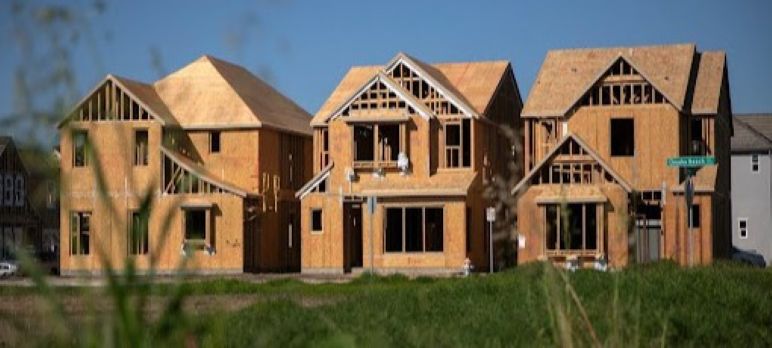
Second, the home has to be newly built or newly converted into housing. In other words, the borrower has to be its first occupant. No re-sales.
Why only new homes?
This gets at a common critique of down payment assistance programs.
Giving some buyers a financial leg up without changing the number of units in circulation just shifts around who gets a house and who doesn’t. It’s like reserving a seat for someone during a game of musical chairs. Your friend might get a spot, but the same number of people will end up on the floor when the music stops.
Worst-case scenario, the new injection of money just pushes prices up further.
Reserving these loans for new units, the idea goes, would help ensure that new supply matches the new demand, resulting in a net increase in the number of homes and California homeowners.
How many homes would actually get built
It could result in the construction of as many as 190,000 homes, according to an analysis commissioned by the Yes on 37 campaign. But the author concedes that’s at the high-end.
To encourage the industry to build eligible homes, the measure includes a “qualified builder” option. If a builder agrees to abide by the measure’s price cap and accept legal responsibility if they violate some basic labor requirements, they’re shielded from construction defect lawsuits as long as they repair any future mistakes to a homeowner’s satisfaction. When disputes end up in court anyway, legal fees would be capped.
The actual number of new units depends on how many builders decide it’s worth it to get qualified, how many of these homes would have been built anyway, the price of home and how much of the down payment each borrower wants to cover with the loan, along with a whole bunch of other unknowns.
There are quite a few unknowns, but the nonpartisan Legislative Analyst’s Office highlighted two big ones in its analysis of the measure.
We don’t know whether investors would actually buy these bonds, and if so, at what rate. We also don’t know how many buyers will actually want to apply for these loans.
Bond buyers might not want to lend the money
Financing second mortgages is considered riskier than funding the traditional kind, because the loans add to a borrower’s debt load, the first loan is first in line to be paid back and the second wouldn’t come with the implicit guarantee of either the state of California or federal mortgage giants Fannie Mae or Freddie Mac. If the borrower goes bust, the investor is on the hook.
Typical investors would want to be compensated for all that added risk. That means high interest rates.
Right now, traditional mortgage rates are blowing past 7%. Ordinary investors “are going to want a fair amount more than that” for an untested, riskier investment, said Edward Pinto, who co-directs the Housing Center at the American Enterprise Institute, a conservative-leaning think tank.
Buyers might not want to use loans
Even if the second mortgage came with a 7% rate, that could add an extra $1,000 to a new homeowner’s monthly debt payments, depending on the price of the home. That’s a steep price to pay for a lower down payment. Less than 40% of Prop. 37-eligible renters would be able to afford these higher monthly payments for an entry-level home, according to the PPIC analysis.
For a house priced at the top of the eligibility range, less than half of one percent of eligible renters would be able to afford it.
Can the state bring down these interest rates?
Public money isn’t supposed to subsidize or backstop these loans, so not directly.
But Hertzberg said he has a plan.
Philanthropic groups and do-gooder foundations — “the Giving Pledge people,” in his words — might be convinced to purchase the bonds at below-market rates, potentially as low as 3%. This would be in the civic-minded spirit similar to buying war bonds during the Second World War, said Hertzberg. But it might also satisfy certain corporate social impact requirements, non-profit mission statements and even federal community lending standards.
He said he’s already spoken to some possible donors about this, but has declined to name names.
So what happens if either investors don’t buy the bonds, buyers don’t take out the loans, or both?
Potentially nothing.
At a recent panel discussion, Chris Hoene, executive director of the left-leaning California Budget & Policy Center, said he was skeptical that Prop. 37 would work as advertised. But he also said the downside is limited.
“It could still work, and if it doesn’t work, the state’s not really on the hook,” he said.
Ben Christopher is a reporter with CalMatters.
