
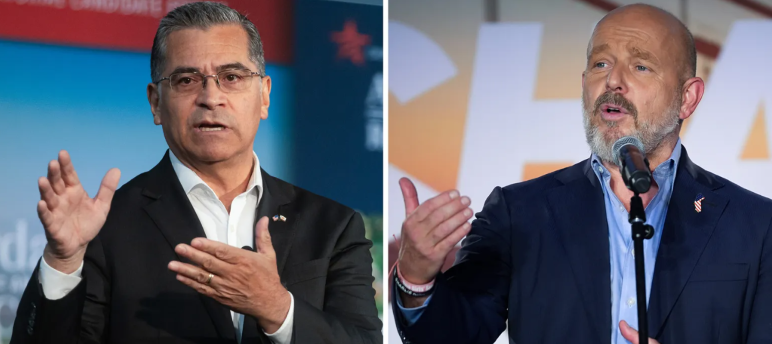
Vote totals released this evening for the California governor’s race left little doubt that Republican Steve Hilton and Democrat Xavier Becerra will meet in a runoff in November. The odds that Democrat Tom Steyer might make the runoff grow slimmer each day.
Today’s percent totals for each of the top six candidates – with an estimated 60% of the ballots counted – varied little from the totals announced 48 hours earlier. This offers no mathematical or statistical reason to believe that third-place candidate Tom Steyer will make the cut.
To move past Becerra, Steyer would need to nearly double his current total, grabbing 40% of the remaining ballots. For Steyer to achieve that near-miraculous feat of getting 2.6 million votes, none of the uncounted votes could be for Chad Bianco, Katie Porter or Matt Mahan, if Hilton and Becerra hold steady.
If Hilton and Becerra increase their current pace of 27% and 26%, respectively, of remaining ballots, Steyer’s chances grow dimmer. If Hilton or Becerra falter in the final 3.6 million ballots, Steyer’s chances grow.
Steyer currently trails Becerra by more than 330,000 votes, and Hilton tops Becerra by more than 63,000 votes. Hilton’s margin over Becerra has been halved since Wednesday morning, while Becerra’s margin over Steyer has grown.
Here are the totals for leading candidates, as of 7:44pm, June 4:
- Steve Hilton, 1,417,689 27.6% 1,533,435 27.2% (+63,335)
- Xavier Becerra, 1,310,710 25.5% 1,470,100 26.0% (+330,583)
- Tom Steyer, 1,013,488 19.7% 1,139,517 20.2%
- Chad Bianco, 579,839 11.3% 629,100 11.1%
- Katie Porter, 236,720 4.6% 255,707 4.5%
- Matt Mahan, 209,175 4.1% 224,045 4.0%
Steyer isn’t conceding
As of late Thursday, Steyer remained defiant and optimistic. His campaign issued a statement that “we’re going to give democracy time to work.”
Mahan and Porter both issued concession statements Tuesday evening.
“I want to congratulate my fellow candidates on a hard-fought campaign,” Mahan said. “While this campaign for governor ends tonight, our mission has only begun.”
“Running a race like this isn’t easy, and coming up short is hard, but democracy is worth doing hard things for,” said Porter. “Stay in the fight, stay in touch, and thank you for believing in me.”
The long list of 61 governor candidates facing voters included two who had dropped out after ballots were printed, Rep. Erik Swalwell and Betty Yee. The list included 36 Democrats and 12 Republicans; the remainder, like a big portion of the electorate, listed no party preference or minor party.
Another 3.6 million ballots still unprocessed
California election officials reported June 4 that approximately 5.6 million ballots – 61% of the the estimated 9.2 million Primary Election ballots – had been processed.
In its first Unprocessed Ballots Report of the 2026 primary, the Secretary of State’s Elections Division estimated that another 3.6 million ballots remain to be processed before the results become official.
The state estimated that 9,224,010 votes were cast. The 40% turnout is higher than most non-presidential primary statewide elections, which have been around 35%.
The Elections Division reported that it had processed 5,617,892 ballots as of 7:44pm June 4, and estimated that 3,606,128 ballots remained to be processed.
The turnout represents a significant number of last-minute voters: Just 14% of mail ballots had been received on or before Election Day.
Why does it take so long?
Why does it take California – arguably the technology capital of the world – a month to count election ballots.
In California, it typically takes weeks for counties to process and count all of the ballots. By law, elections officials have approximately one month to complete their extensive tallying, auditing, and certification work (known as the official canvass).
Every active, registered voter was sent a vote-by-mail ballot. Vote-by-mail ballots postmarked on or before Election Day and received by the county elections official no later than seven days after the election will be processed and can be counted. In processing vote-by-mail ballots, elections officials must confirm each voter's registration status, verify each voter's signature on the vote-by-mail envelope, and ensure each person did not vote elsewhere in the same election before the ballot can be counted, according to the Secretary of State’s Election Division.
Also, other ballots that are processed after Election Day include provisional ballots (processed similar to vote-by-mail ballots), conditional voter registration provisional ballots and ballots that are damaged or cannot be machine-read and must be remade by elections officials.
State law requires county elections officials to report final official results to the Secretary of State by July 3. The Secretary of State has until July 10 to certify the results of the election.
The $300 million primary campaign for governor was the most expensive in California history.
More than two-thirds of that total came from Steyer’s own deep pockets. He spent more than $216 million. Independent expenditure committees pitched in nearly $80 million, spread among the top six candidates.

Reportedly, federal prosecutors are on site at the Los Angeles ballot counting facility.
Seems newsworthy.