
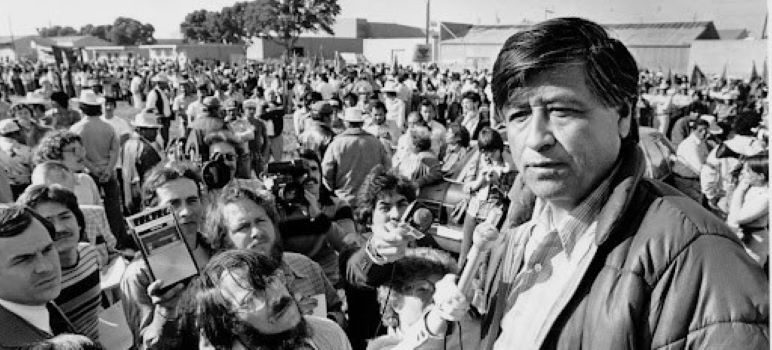
Revelations of allegations of decades of sexual abuse by the late farm worker labor legend César Chávez cited Tuesday by the United Farm Workers and the César Chávez Foundation and reported in detail today by The New York Times have prompted cancellations of celebrations of his March 31 birthday across several states, including California.
The farm worker union co-founded in 1962 by Chávez and Dolores Huerta and the foundation canceled their participation in all César Chávez Day celebrations Tuesday after learning of the pending Times report.
César Chávez Day was made a state holiday in 2000 and a federal commemorative holiday in 2014.
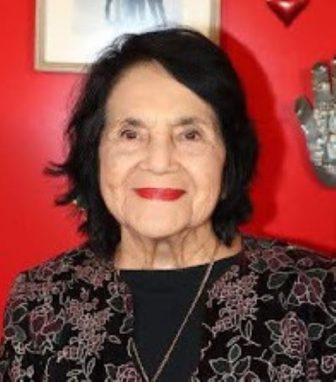
Dolores Huerta, 95, lives in Delano. Huerta website photo.
After the publication of the Times investigation, Huerta released a shocking statement that Chávez had forced her to have sex with him on two occasions in the 1960s: “I can no longer stay silent.”
“I have kept this secret long enough. My silence ends here,” she said. Huerta, who turns 96 next month, lives in Delano in California’s Central Valley.
San Jose Mayor Matt Mahan announced today that the city was canceling all César Chávez Day events, in light of the sex abuse allegations, “to ensure we are not further traumatizing survivors.” Mahan said the city “will identify ways to honor the legacy of the farmworker movement without celebrating individuals who caused such profound harm to the community.”
On Tuesday he had said that that “given Chavez’s ties to San Jose, we want to ensure we are not further traumatizing anyone who may have experienced harm, and are reassessing city involvement in events associated with the state holiday until we learn more.”
Mahan, along with Councilmembers Pamela Campos, Peter Ortiz and Domingo Candelas, said today the city also will initiate a process “to identify locations, monuments, and other sites bearing Chavez’s name or likeness and drive a community-driven initiative that appropriately honors the broader farmworker justice movement without causing further harm to survivors.”
Chávez lived in East San Jose for several years, where his home is a city historical monument. In 1993, Plaza Park in San Jose was renamed Plaza de César Chávez. Chávez died in 1993 at age 66.
Contra Costa County announced late Tuesday it was canceling all César Chávez Day celebrations.

Status of this year's San Francisco parade was in doubt March 18. Poster from parade website.
In San Francisco, officials said today they were reevaluating the status of the annual César Chávez and Dolores Huerta Parade and Festival, scheduled for April 11.
In addition to Contra Costa County, San Bernadino, the state of Arizona, Houston and several other Texas cities canceled Chavez Day events set for March 31, a state holiday in California and other states.
Two women, Ana Murguia and Debra Rojas, told The New York Times that Chávez abused them for years starting when they were 12 or 13 years old. The Times report was based on on-the-record interviews with victims and was corroborated by interviews with over 60 aides, relatives, and union members, along with a review of union records, photographs, and audio recordings.
“I carried this secret for as long as I did because building the movement and securing farmworker rights was my life’s work,” said Huerta. “The formation of a union was the only vehicle to accomplish and secure those rights and I wasn’t going to let César or anyone else get in the way.”
In her statement, Huerta said that she felt disturbed by the allegations that Chávez had harmed girls. She emphasized that his actions didn’t represent the values of the movement that they led together. “My heart aches for everyone who suffered alone and in silence for years. There are no words strong enough to condemn those deplorable actions that he did,” she said.
The César Chávez Foundation posted a statement on its website Tuesday.
“We are deeply shocked and saddened by what we are hearing,” the foundation said. “The foundation is working with leaders in the Farmworker Movement to be responsive to these allegations, support the people who may have been harmed by his actions, and ensure we are united and guided by our commitment to justice and community empowerment.”
“In partnership with the UFW, we are establishing a safe and confidential process for those who wish to share their experiences of historic harm, and, if they choose to, participate in efforts toward repair and reconciliation.” the foundation said. “In addition, we are investing time and resources to ensure the Foundation promotes and strengthens a workplace culture that is safe and welcoming for all.”
“We ask for our community’s patience as we learn more.”
The United Farm Workers announced Tuesday that the labor organization will not participate in any activities on March 31 because of the allegations that Chávez was involved in the “abuse of young women or minors” as well as “family issues.”
The union did not share specifics of the allegations, adding that reports had not been made to the organization firsthand.
“Allegations that very young women or girls may have been victimized are crushing,” the union said in its statement. “The allegations are serious enough that we feel compelled to take urgent steps to learn more and provide space for people who may have been victimized to find support and to share their stories if that is what they choose.”
The union urged people to instead take part in acts of service or actions to “support farmworkers or empower vulnerable people in their own communities.”
The union said it was also working to establish a channel to support those who may have been harmed by Chåvez while he worked for UFW.
“These allegations have been profoundly shocking,” the union said. “We need some time to get this right, including to ensure robust, trauma-informed services are available to those who may need it.”
Canceling events, the union said, would “provide space for people who may have been victimized to find support and to share their stories if that is what they choose.”
The United Farm Workers of America is the nation’s oldest farm worker union. The UFW continues organizing in major agricultural sectors, chiefly in California. The UFW has dozens of union contracts protecting thousands of farm workers, among them agreements with some of the largest berry, winery, tomato, dairy and mushroom companies in California and the nation.
Many UFW-sponsored laws and regulations protect all farm workers in California, especially those at non-union ranches. They include the first state standards in the U.S. to prevent further deaths and illnesses from extreme heat and in 2016 the first law in the country providing farm workers in California with overtime pay after eight hours a day.

Interesting.
Cesar Chaves fought for the rights and protections of legal farm workers, not the illegals.
These allegations muddy the achievement concerning the use of “short-handle hoe(s).”
David S. Wall
Chavez was staunchly opposed to illegal immigration, accurately recognizing it diluted UFW wages.
This is now a deep and wide stain on Chavez’s legacy. It’s so, so unfortunate. I don’t know what the right thing to do is, but I hope there is thoughtful reflection before all the signs are pulled down and streets renamed. But something should be done, but with mindfulness.
Wasn’t Chavez’s brutality a well known fact this entire time? I thought it was common knowledge he would go on runs where they beat illegal aliens with chains to scare them back to Mexico. All these activists are mentally ill, I have no reason to doubt Huerta’s claims about Chavez, but then to partner with his brother to have 4 children seems like cult behavior. Keeping it a secret is neither honorable nor responsible, as it seems Chavez was a brutal psychopath all along and only lead to more abuse.
People – this just in – all cults are sex cults.
Where can I find information on the runs where Chavez beat illegal aliens with chains? Can you tell me where you got this information from?
“Wet Lines” – participants personal histories. Pretty common knowledge I thought.