
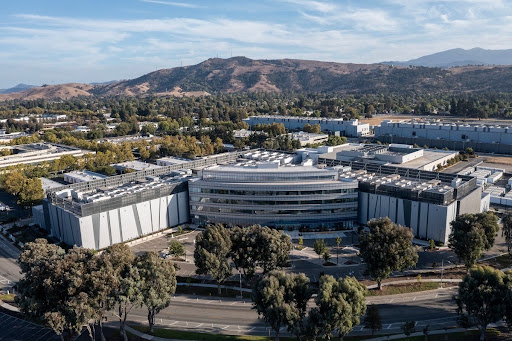
As the cities of San Jose and Gilroy and the California Legislature are tackling ways to regulate the dramatic expansion of data centers, data center growth in California and nationwide shows no signs of slowing.
In fact, an analysis of national and state data shows that hundreds of data centers are already solid fixtures in major tech centers like Silicon Valley, Austin and Northern Virginia.
“The race to build AI infrastructures is unfolding town by town across America,” legendary environmental activist Erin Brockovich wrote in May. “In some places, data centers are welcomed. In others, they are delayed, contested or abandoned altogether.”
The tracking website Data Center Map reports that San Jose already has 47 data centers, and city officials have said that as many as 34 new projects are under review.
Residents and climate groups in the city have demanded a temporary construction moratorium, expressing concerns over strain on the power grid, water use and carbon emissions.
In response, the City of San Jose began hosting community forums across the city on the topic, leading to City Council policy discussions later this year.
A three-day AI Infra Summit 2026 begins Sept. 15 at the Santa Clara Convention Center. The conference will focus on artificial intelligence, data center infrastructure, scalability and energy challenges. Hundreds of Silicon Valley executives are expected to attend, hearing speakers that include Intel CEO Lip-Bu Tan.
“We could bury our heads in the sand, say ‘no’ and push the jobs and industries of the future to states with fewer environmental safeguards, or we can do what California does best: lead the nation forward with a blueprint for responsible development,” the mayor said in a newsletter this month.
Mahan has staked a large part of the city’s future on the development of data centers. Last year, he announced an agreement with PG&E to deliver, via upgrades, more than 2,000 megawatts of energy to make San Jose the “West Coast’s premier destination for data center development.”
In June, the mayor presided at groundbreaking ceremonies for a Microsoft data center in Alviso, and described data centers as “critical infrastructure.”
The San Francisco Standard reported that since Mahan took office, San Jose has approved more than 1 million square feet in data center development.
Statistics provided by Data Center Map, one of several data center tracking websites, lists 4,767 data center sites across the U.S., with California reporting the third-highest number, 296, after Texas (537) and Virginia (674). The Data Center Map list includes sites in operation and sites under development.
Some energy watchdogs are warning that increased energy needs of the growing numbers of data centers will require new electric transmission lines requiring new funding from consumer rate increases. Water watchdogs are warning that data centers also are future guzzlers of public water supplies in many areas experiencing ongoing drought conditions.
In the City of Santa Clara, ground zero for data centers in California with 69 sites, 60% of the city-owned utility’s energy goes to the city’s data centers, according to a report by CalMatters.
Air quality also is an issue.
The same report cited a Lawrence Berkeley National Laboratory study compiled for the Department of Energy that estimates that data center energy use has tripled over the past decade and is projected to double or triple by 2028. A Morgan Stanley report released last fall found that within five years, the global data center industry could produce 40% of annual U.S. emissions, according to Reuters..
By 2030, data centers could contribute to 1,300 premature deaths in California, carry $20 billion in health care costs, and rival greenhouse gas emissions of every car in California as a cause of health costs, according to an evaluation published last month by California Institute of Technology and UC Riverside researchers, as reported by CalMatters.
The Data Center Map website lists 12,259 data centers in 179 countries, 4,767 of them in the U.S.
The U.S. data center total dwarfs other countries across the planet, with 568 in the U.K., 533 in Germany, 393 in France, 376 in China, 305 in India, 296 Australia, 292 in Canada, 261 in Japan – and 188 in Russia.
In the U.S, top five states are: 674 in Virginia, 537 in Texas, 296 in California, 276 in Georgia, 242 in Illinois
In California,the top five cities are: 69 in Santa Clara, 59 in Los Angeles, 47 in San Jose, 19 in Sacramento, 15 in San Diego.
In San Jose, the data centers are often clustered near each other: 10 in the Alviso in north San Jose, five near San Jose Mineta International Airport data centers, another five along Trade Zone Boulevard in northeast San Jose.
Four data centers are within a few blocks of City Hall in the center of downtown.
More than a dozen data centers are clustered in south San Jose, along the Coyote Valley: six are clustered along San Ignacio Avenue, and seven nearby along Great Oaks Boulevard.
In some cities, public opposition has derailed projects.
The Pew Research Center says the demand for land, power and water is shifting much of the new development to rural areas.
Near Mt. Shasta, plans for an artificial intelligence data center proposed at the former Crystal Geyser water bottling facility were scrapped after public opposition.
In June, a San Diego-based data center developer had inquired about purchasing the vacant former Crystal Geyser bottling plant. The site is located in unincorporated Siskiyou County, just outside the Mount Shasta city limits. The location was targeted primarily because of its valuable water rights and high-producing volcanic aquifer water well.
The proposal immediately faced massive pushback from residents, environmental groups, and the Winnemem Wintu Tribe. An online petition opposing the project quickly gathered tens of thousands of signatures: The city of Shasta estimated the center would create only about 15 long-term jobs while generating little to no local tax revenue since it would not manufacture a retail product.
City officials received hundreds of hostile emails and violent threats, prompting the Mount Shasta Police Department to step up security at city hall.
Mount Shasta City Manager Todd Juhasz declared the project "dead on arrival," stating that the city would formally reject the inquiry. Because the property is in unincorporated county territory, Mount Shasta leaders have explored annexing the land to establish permanent local zoning control and safeguard their water supply. Siskiyou County officials also confirmed that no official development applications were ultimately filed.
There are multiple sources for information about data center expansion.
Data Center Map is a long-standing, global digital infrastructure research directory mapping data centers and ‘cloud facilities’ worldwide.. A citizen-run collaborative mapping project, the Data Proposal Tracking Center, tracks and visualizes data center projects and energy grid and infrastructure in the U.S.
Brockovich this year launched a crowd-sourced mapping platform to track U.S. data center expansion and community impacts. The FracTracker Alliance also announced its U.S. Data Centers Tracker, which uses public records, FOIA requests and permit documents to focus on environmental and regulatory impacts of data centers.

Besides his data center jihad, convicted perjrer Beckerv is stalking school board meetings demanding Kathy Watanabe resign and withdraw from Mayors race
Becker, a felon, should not be dealing with school.