
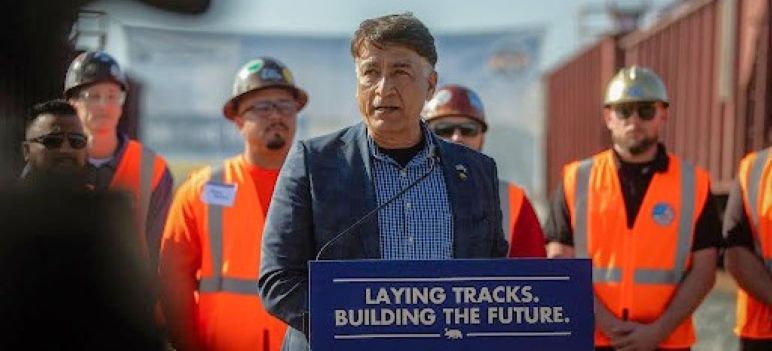
The CEO of California’s high-speed rail authority resigned late Wednesday, saying he needs to focus on “important personal and family priorities,” according to a copy of the emailed resignation obtained by CalMatters.
“This has not been an easy decision, as leading the authority has been one of the most meaningful and rewarding chapters of my professional life,” wrote Chief Executive Ian Choudri.
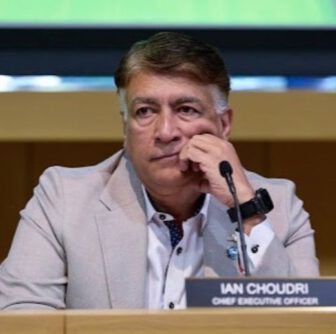
Ian Choudri resigns as High Speed Rail CEO. Photo by Fred Greaves for CalMatters
The abrupt announcement comes in the midst of a two-day meeting of the board that oversees the project, which continues Thursday. It follows Choudri’s tumultuous two-year tenure, which has been troubled by budget woes, project delays, transparency concerns and various scandals including the misuse of nearly $600,000 in taxpayer money for questionable trips by rail authority consultants.
Under Choudri, the authority also lost $4 billion in federal funding under President Donald Trump’s administration, after the agency repeatedly missed deadlines required by the funding agreement to buy trains. The state initially sued Trump for the funding but abruptly dropped the lawsuit in December 2025, blaming Trump as “not a reliable partner” and turning to private investors instead.
Choudri did not respond to an email or text from CalMatters requesting comment Wednesday night. It is unclear when his last day will be.
State investigators last month found the rail agency’s consultants flew first class, hailed premium rides and traveled to a nightclub, cigar lounge and restaurants on taxpayers’ dime, sometimes at Choudri’s request. Many of the trips involved traveling to Folsom, the Sacramento suburb where Choudri has a home, sometimes after hours.
The board voted earlier this month to limit Choudri’s contracting authority following the probe, requiring the in-house legal counsel to sign off first on contracts under $25 million.
The board has been weighing additional disciplinary action against Choudri for weeks, including possible termination, according to a source with the authority who spoke on the condition of anonymity because they were not authorized to speak on the matter.
California voters in 2008 approved a $10 billion bond to build a bullet train connecting San Francisco to Los Angeles by 2020, with a projected cost of $45 billion. But progress stalled amid rising costs, legal fights and funding uncertainties.
The authority’s latest business plan said the project could now cost between $126 billion and $231 billion, with the current 171-mile leg between Merced and Bakersfield under construction, and a full buildout expected by 2040.
The board was supposed to decide at the meeting this week if Choudri qualified for a potential $25,000 bonus based on his performance this year, agency spokesperson Micah Flores told CalMatters last month.
Choudri’s compensation this year is more than $534,000, according to agency spokesperson Annie Parker.
Cost overruns, project delays, legal challenges
Choudri was hired in August 2024 after spending decades in transportation engineering, with experience building high-speed rail in France and Spain. The board hired him in part due to his “strong understanding of complex transportation projects,” according to then-board chair Tom Richards.
Under Choudri, the agency has continued construction of the Central Valley segment and is on the cusp of getting environmental clearance from the state for all 500 miles of planned railway between San Francisco and Southern California. Newsom, a big supporter of the rail project, has committed $1 billion a year from the state’s climate fund toward the rail project until 2045.
Choudri has also led efforts to cut consultant contract costs, attract private investments and speed up contracting, rail authority chief of staff Mark Tollefson said during a Wednesday presentation touting Choudri’s achievements.
On Wednesday, the board unanimously approved a $772.1 million contract to Germany-based Siemens Mobility, Inc. to design, build and test three seven-car high-speed bullet trains by 2030. The authority will also pay up to $63.7 million in import duties and tariffs, because the trains will be designed and built in Germany.
The vote comes three years after the agency first opened bidding for six trainsets in August 2023 to qualify for more than $3 billion in federal grants, before ultimately losing the funding following missed deadlines.
In his resignation letter, Choudri said he was proud to have transformed the project.
“I took on a project facing significant challenges and serious questions about its prospects for success, and led its turnaround into a successful program,” he wrote.
But the project has continued to face significant cost overruns, schedule delays and lawsuits.
The train agency could run out of cash by December 2027, the office of inspector general warned in July. Meanwhile, the authority failed to make clear in its latest business plan that the Central Valley segment is now expected to be completed by 2034 at a cost likely exceeding $40 billion, the inspector general said.
The authority also based its project schedule on the assumption it would achieve legislative proposals it failed to push through this year.
To save money, the authority proposed shrinking the Merced-to-Bakersfield segment by 9 miles and moving the downtown Merced station to South Merced, in apparent violation of state law. It also requested an exemption from environmental regulations and solicited contractors for the new location, prompting a lawsuit this month from the Central Valley coalition Community Alliance for a Sustainable Economy.
“This challenge follows an unlawful pattern of behavior by the HSRA — proposing to relocate the downtown Merced station, then acting as if that move has been approved when it has not,” the complaint said.
Questionable trips plague the authority
Between 2024 and 2026, employees from four consulting firms working for Choudri’s agency billed the state for questionable trips to locations including gyms, a nightclub, an escape room, a tiki bar and a cigar lounge, according to last month’s probe by the inspector general’s office overseeing the rail agency.
Many trips were poorly justified, yet the agency routinely reimbursed them without sufficient vetting, the inspector general said.
One legal consultant traveled between Denver and Sacramento 30 times in a year, charging the state $86,500 in “travel time” payments and an additional $40,800 in reimbursements.
In a testy meeting earlier this month, the board accused them of using the agency as a “piggy bank.”
On Wednesday, authority staff reported that the consulting firms have paid nearly $1.3 million in reimbursements to the agency.
CalMatters filed a public records request last month seeking the questionable travel invoices from the inspector general’s office. The agency provided records only from one firm, Nossaman, arguing that the records for other consultants are related to audits or investigations and therefore are not required to be publicly disclosed under a recent law signed by Gov. Gavin Newsom.
The records that were released were heavily redacted by both the inspector general’s office and the rail agency, which argued much of the information is protected by attorney-client privilege.
Yue Stella Yu is a reporter with CalMatters.
