
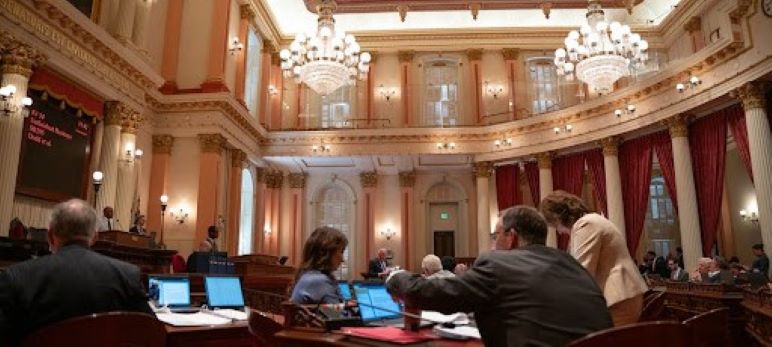
If signed by Gov. Gavin Newsom, a bill passed Aug. 31 by supermajorities in the California Legislature would be the most economically significant law supporting local news in the country, possibly in American history.
The Community Newsroom Employment and Workforce Sustainability Act (the Community NEWS Act, AB 2222) was introduced earlier this year by Assemblymember Christopher M. Ward and sponsored by Rebuild Local News.
The bill would create refundable tax credits for California local news organizations based on the number of journalists they employ, with enhanced benefits for the smallest community news providers and outlets creating new journalist jobs. Commercial and nonprofit news outlets of all mediums are eligible.
AB 2222 is estimated to provide more than $40 million per year to news outlets around the state.
The bill is structured to support community news while preserving editorial independence and preventing government officials from rewarding or punishing outlets based on content. We work closely with the Reporters Committee for Freedom of the Press to ensure that all of Rebuild Local News’ approaches are First-Amendment-friendly, nonpartisan and content neutral.
The benefits
The job retention credit is worth $20,000 per journalist for up to five full-time positions, plus $15,000 per every additional journalist. Part-time journalist positions would be supported with $7,500 credits. A $15,000 new hire credit would be awarded to news organizations that expand journalist headcount, which is stacked on top of the retention credits. Even though it’s a “tax credit,” because it is “refundable,” that means the news outlet would get cash if the credit exceeds their tax burden.
AB 2222 is fully paid for and strengthens California’s budget because it is financed by a measure that would end corporate tax breaks for executive compensation above $1 million. Federal law does not allow this type of corporate tax break, and with this bill California’s legislature decided to align their tax law and use most of the money to support community news jobs.
Eligibility
We designed this policy so that local print, digital and broadcast outlets alike benefit, regardless of whether they are for-profit businesses, 501(c)3 nonprofits or sole proprietorships. Outlets can apply as any one of the following types:
- Digital news outlet: Must have a primary mission of publishing news about California or a local community, publish at least monthly, and prove that at least 33% of its audience is located within the state. (Print or broadcast outlets with digital presences can also qualify.)
- Broadcast station: Must be FCC-licensed to a community of license within the state or be a public broadcaster.
- Print publication: Must be a court-certified newspaper of general circulation in California, have a USPS periodicals mailing privilege, or prove at least 33% of its distribution is within California.
Additional standards apply to all organizations, regardless of media type:
- Established presence: The outlet must be either organized in California or legally registered to do business in the state for at least 12 months before the tax year begins.
- Ownership disclosure: The outlet must publicly list all beneficial owners, or its board of directors if it is a nonprofit, on its website or in its publication.
- Corrections policy: The outlet must maintain and publicly display an editorial policy for error correction and provide an accessible way for the public to report complaints.
- Insurance: The outlet must carry active media liability insurance throughout the tax year.
- Independence from political control: The organization cannot be controlled, directly or indirectly, by a Political Action Committee (PAC) or a 501(c)(4).
To claim the credit, the journalists employed must meet these standards:
- Full-time position: Must work at least 30 hours per week and earn at least $35,000 annually.
- Residency: Must be a resident of California and have primary job duties in the state.
- Job duties: Must involve gathering, preparing, directing the recording of, producing, collecting, photographing, recording, writing, editing, reporting, presenting, or publishing state or local community news for dissemination to the local community, including roles such as reporter, correspondent, photographer, videographer, editor and digital producer.
Broad support and advocacy
As of this writing, the bill got the 54 votes necessary Monday for a supermajority in the Assembly, with the leadership not only of Assemblymember Christopher M. Ward but also Assemblymember Buffy Wicks, another champion of local news. Coauthored in the senate by Senator Jerry McNerny, the chair of the Revenue and Tax Committee, it received a 29-10 floor vote on Sunday.
The legislation gathered a historically broad media coalition of support in California history, including small and large publishers, ethnic media, labor unions and local TV stations. Associations that endorsed the legislation include:
- Media Guild of the West
- California News Publishers Association
- SAG‑AFTRA
- California Independent News Alliance
- California Broadcasters Association
- Pacific Media Workers Guild of The NewsGuild‑CWA
- Latino Media Collaborative
- American Community Media
- California Black Media
- Institute for Nonprofit News
- Local Independent Online News Publishers
- Asian American Journalists Association of Los Angeles
- The Journalism Chairs of the Cal State University System
- News/Media Alliance
In addition, many individual publications endorsed the bill, including The LA Local, Lookout Local, Cityside Journalism Initiative, The Sacramento Observer, CalMatters, La Opinion, Hispanic LA, Napa Valley Register and many more.
Rebuild Local News has created model legislation that’s quite similar to the bill just passed by the California legislature. Versions of this have also been enacted in Illinois, New Mexico and New York.
Steven Waldman is president, Matt Pearce is director of policy and Gene Perry is senior policy manager of Rebuild Local News.
