
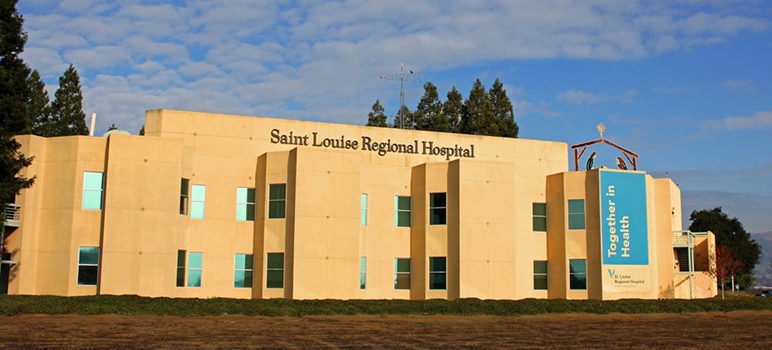
Santa Clara Valley Healthcare has expanded cardiology services at Saint Louise Regional Hospital, bringing diagnostic heart care closer to South County residents who previously had to drive up to an hour to San Jose for the same services.
The new cardiac diagnostic center that opened Jan. 6 offers echocardiography, continuous heart monitoring and treadmill stress testing, among other services, which officials say will reduce travel burdens and potentially save lives in a community where heart disease disproportionately affects the Latino population.
“We’re not only serving South County, we’re also helping decompress some of the volumes in San Jose,” said Dr. Sumit Sehgal, the county-hired cardiologist leading the expansion, noting that Saint Louise has already begun serving patients referred from other county hospitals.
The expansion comes as the county's public healthcare system faces a $1 billion funding cut from federal legislation HR 1, passed in July. Despite the financial pressures, county leaders emphasized their commitment to addressing health disparities in South County.
“South County is a priority for the healthcare system and the county,” said Paul Lorenz, CEO of Santa Clara Valley Healthcare. “We know there’s a growing need in this county, but particularly in South County and the surrounding communities.”
Saint Louise Regional Hospital’s emergency room serves an average of 130 patients daily, with volumes reaching up to 160 during peak seasons, Lorenz said. The county acquired the hospital in 2019.
The new services address critical gaps for a population that faces significant health challenges. According to a Latino Health Study conducted by the county last year, Latinos in the area live two years less than their counterparts, with heart disease being the leading cause of death in the Latino community.
“The Latino community has had a death rate from coronary heart disease that is higher than the national average,” said Supervisor Sylvia Arenas, who represents District 1. “These kinds of disparities show an underinvestment.”
Arenas described the personal impact of inadequate local cardiac care, recounting how a friend experiencing a heart attack had to drive themselves to San Jose because appropriate services weren’t available locally.
“Minutes matter, seconds matter,” Arenas said. “We want to make sure that you don’t have to drive an hour to San Jose or somewhere else to get the kind of services that you deserve.”
Dr. Olivia Lee, physician executive at Saint Louise Regional Hospital, said the expansion represents more than just new equipment. The new cardiac diagnostic space consolidates multiple services under one roof at the Gilroy hospital. The center includes specialized staff and streamlined processes that significantly reduce turnaround times for test results.
“This makes it easier for working families,” Lee said of the improved accessibility of foundational cardiac testing services.
The services include echocardiography, which uses ultrasound to visualize heart muscle movement; Zio Patch monitoring, which tracks heart rhythm and electrical conduction over extended periods; and treadmill stress testing, which evaluates heart function during physical exertion.
Lee praised Sehgal’s expertise across multiple cardiac diagnostic techniques. “Not every cardiologist can read all of these modalities, but this guy, he can do it all,” she said.
Sehgal relocated from Iowa to join the county healthcare system two years ago. After meeting with Lee about her vision for South County cardiac care, Sehgal and his family bought a house in Gilroy to root themselves in the community they would serve.
“In my first interview with Dr. Lee, she shared her vision with me and said, ‘We need to create a robust cardiovascular service line in South County. Can we do that?’” Sehgal recalled. “And I said, ‘You know what, we’re going to work together and make that happen.’”
During the past two years, the team streamlined ECG processes, established an inpatient pacemaker and implantable cardioverter-defibrillator program, and launched the Zio Patch monitoring service. Volume has surged as services became available, Lee said.
Planning for the expansion began about a year ago, before the federal funding cuts were announced, according to Arenas.
“This investment here is not compromising the rest of the system. It is enhancing it,” Arenas said. “It’s an underserved community, and so we have to invest where the need exists.”
Michael Elliot, executive director of the Valley Health Foundation, emphasized the significance of the investment during a challenging time for public hospitals nationwide.
“In the kind of environment that a public hospital system like Santa Clara Valley Healthcare is operating right now, any new investment is a really big deal,” Elliot said. “There are hospitals like this around the country that are closing their doors right now.”
Lee said the new cardiac center lays a foundation that will allow for future expansion of cardiac services beyond the current diagnostic offerings. The goal is to continue building layers of specialized care while also supporting the broader county healthcare system.
“Without the space, without the specialist, without the expertise, you can’t actually go out there and do all these things,” Lee said. “This lays the foundation.”
